AI Security Cameras with Stranger Detection: Are They Truly Secure?
Read more
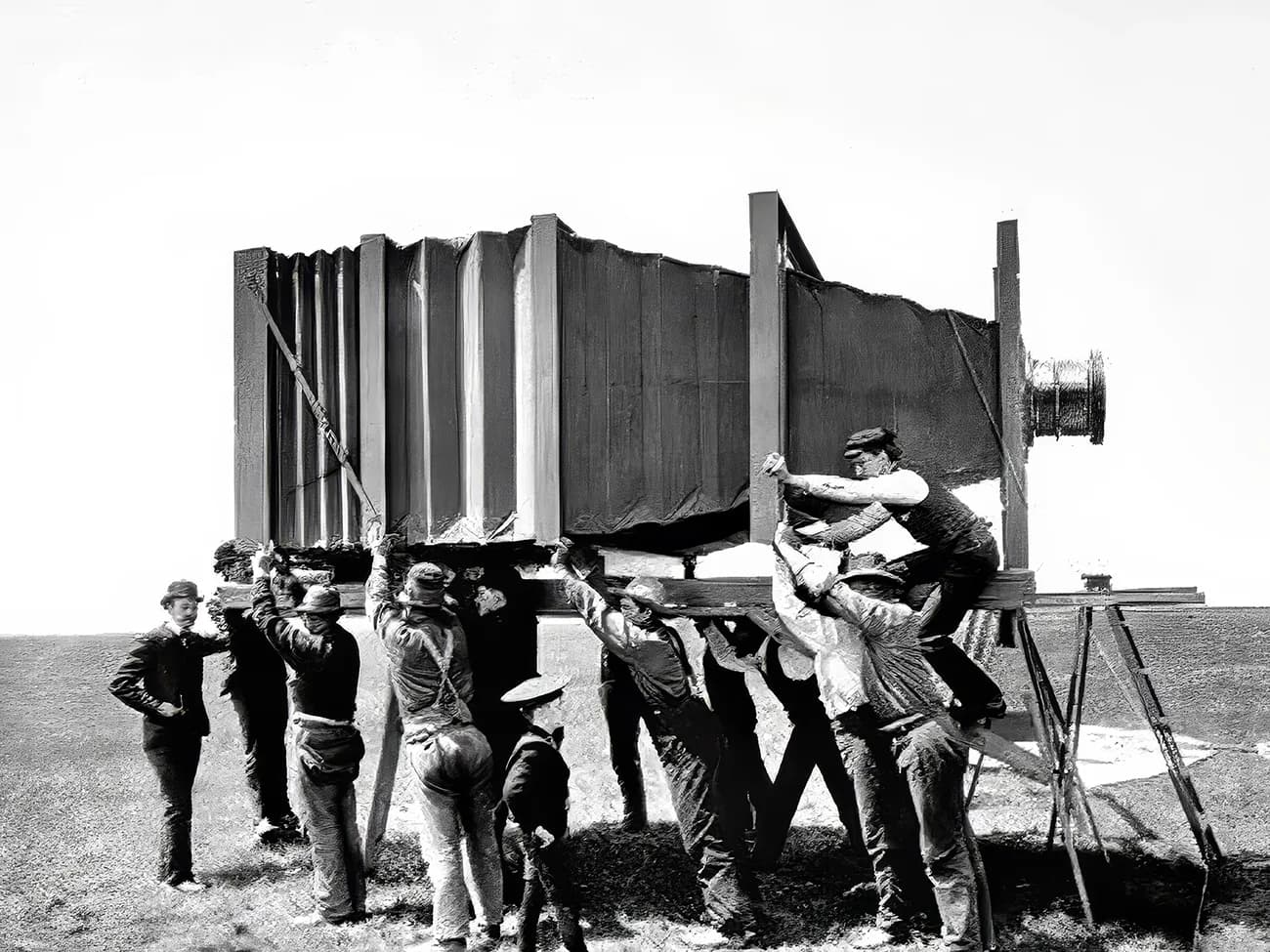
When people search for "the first camera," they often visualize a small wooden box that clicked once and instantly produced a black-and-white photograph. In the history of optics, however, the invention of the camera was not a single breakthrough that occurred overnight.
It was the convergence of two distinct journeys spanning centuries: humanity's yearning to replicate the natural world (optics) and the stubborn ambition to fix that fleeting projection permanently onto a flat physical surface (chemistry). As explored in our reflection on how AI is transforming photography, technological turning points are almost always born out of aesthetic crises in human history.
To understand the core essence of the camera in your hands today, we must journey back to when humans first became fascinated by light slipping through tiny apertures.

The driving forces that motivated inventors were far removed from casual vacation snapshots or social media portraits. They originated from three pressing problems across different eras:

In the 4th and 5th centuries BCE, Chinese philosopher Mozi and later Aristotle in Greece observed that sunlight passing through a tiny hole in foliage or wall cracks projected an inverted image of the outside world onto the darkened interior.
By the 11th century, Arab scholar Ibn al-Haytham (Alhazen) rigorously formalized this optical phenomenon into a scientific experimental apparatus. His primary goal was creating a darkened room to observe solar eclipses safely: rather than burning human retinas by staring directly into the sun, astronomers could stand comfortably inside complete darkness and view the sun's path projected safely against the opposing wall.

During the 16th and 17th centuries, Western painters entered an era obsessed with mathematical perspective and realism. Master artists like Leonardo da Vinci and later Johannes Vermeer needed an instrument to compress a three-dimensional world onto a flat two-dimensional canvas without proportion errors.
They shrunk the dark room down into a portable wooden box. This device could not yet record anything permanently; it functioned purely as an optical projector. The artist observed the projected image cast onto a ground-glass pane and placed tracing paper on top to trace lines with mechanical precision.
The true breakthrough that transformed an optical projection box into a genuine photographic camera took place in the early 19th century, led by French inventor Joseph Nicéphore Niépce.
Niépce was captivated by lithography, the booming printing technology of his day. But he faced a fatal obstacle: he had zero drawing ability. Unable to illustrate stones for printing, he asked a radical question:
"If nature's light already paints a flawless optical picture inside the darkened box, why must human hands laboriously trace it? Can a chemical compound remember and fix the drawing of light on its own?"
That revolutionary inquiry birthed mechanical image capture.
To understand how early cameras were engineered, historians separate development into two fundamental milestones:

The Latin word "Camera" means "chamber" or "room", while "Obscura" translates to "darkened."

The camera that recorded the earliest surviving permanent photograph from nature (View from the Window at Le Gras, c. 1826–1827) was built by Niépce with optical support from Parisian optician Vincent Chevalier.

In physical terms, the first cameras operated entirely on the linear propagation of light particles (photons):
External Subject (Trees / Architecture)
       \       |       /
        \      |      /
     [ Pinhole or Convex Lens ]
        /      |      \
       /       |       \
Inverted Image Projected on Receiving Plate

When stripped to its essence, the underlying mechanics of cameras haven't changed in centuries; only the recording materials and speed have evolved:
| Characteristic | Camera Obscura / Niépce Box (19th Century) | Modern Mirrorless System |
|---|---|---|
| Chamber | Dual wooden sliding boxes | Monocoque magnesium alloy chassis |
| Optics | Single meniscus lens (high aberration) | 8–15 multi-element aspherical groups |
| Focusing | Manual sliding of rear wooden housing | High-speed linear stepping electronic motors |
| Shutter | Manual brass lens cap removed by hand | Mechanical (1/8000s) or Electronic (1/32000s) |
| Image Plane | Bitumen pewter plate / Silver halide | Multi-megapixel CMOS / BSI digital sensors |
| Exposure Time | 15 minutes to 8 hours | Fractions of a millisecond |
Studying early photographic history yields a profound realization: At its core, a camera is nothing more than an empty, light-sealed box.
Appreciating mechanical origins liberates photographers from technological obsession. It refocuses creative attention on observing natural light, direction, and spatial composition—whether working with analog film, vintage digicams, or the latest digital flagships.
Who actually invented the first camera? There is no single inventor. Optically, Arab scholar Ibn al-Haytham laid the theoretical foundation for the Camera Obscura in the 11th century. For permanent mechanical image capture, Joseph Nicéphore Niépce produced the first photograph in 1826, while his partner Louis Daguerre commercially popularized the Daguerreotype in 1839.
Why are images projected through a basic camera inverted? Because light travels in straight lines. As light rays cross through a restricted opening (a pinhole or lens center), rays from the top of an object travel downward to the bottom of the opposing surface, while rays from the bottom travel upward, forming an inverted image.
What was the subject of the world's first photograph and how long was the exposure? The earliest surviving photograph, View from the Window at Le Gras, depicts the rural estate outbuildings of Niépce’s family property in Saint-Loup-de-Varennes, France. It required an estimated 8-hour continuous exposure in direct sunlight.